
Criminal Court Cases in Allegany County
Allegany County Court is the felony trial court. It sits at 7 Court Street in Belmont and shares authority over misdemeanors and minor offenses with the county's Town and Village Justice Courts. A felony arrest often begins with arraignment in the local court closest to the event. After a grand-jury indictment or superior-court information, the prosecution moves to County Court. That shift creates separate court references, so a search confined to the first arraignment court can miss the later felony docket.
The judiciary, rather than the ordinary County Clerk archive, maintains these criminal files. The official Allegany County Court page lists the criminal clerk channel, court hours, and contact details. Town and Village clerks keep their own local matters. Save the exact court name and docket or indictment number whenever possible. Those details help staff distinguish a lower-court case from a transferred County Court prosecution.
Searching Allegany Cases in WebCriminal
WebCriminal is New York's free public channel for pending criminal matters and future appearances. It supports defendant, case-identifier, and calendar searches. Choose Allegany County as a narrowing field when the interface permits. Exact spelling and a known case number reduce false matches. A blank result does not prove that no case exists. Sealed matters, older files, some local-court data, and cases without a pending appearance may not show there.
Use the public entry as a locator, not as the whole court file. Record the case number, court, status, charge citation, and next date before calling. WebCriminal can use CAPTCHA and session controls, and its interface may work more smoothly on a desktop browser. Downloadable criminal documents are not guaranteed. The originating clerk remains the reliable source for a docket sheet, disposition, certificate, or public filed document.
Allegany County Case Record Searches
Start with the narrowest official source that fits the question. WebCriminal works best for an active prosecution or upcoming appearance. The local justice-court clerk can trace an arraignment, misdemeanor, violation, or local matter. Allegany County Court handles the superior-court file. OCA Criminal History Record Search, or CHRS, provides a separate paid statewide name-based disposition search, but it is not fingerprint-confirmed.
- Open WebCriminal and select the defendant-name, case-identifier, or calendar route that matches the information in hand.
- Choose the criminal court system, enter the name carefully, and narrow the results to Allegany County when possible.
- Use a known docket, indictment, or case number for the strongest match and note the court shown on the result.
- Read the status, filed counts, and future appearance, then check whether the case moved from a Town or Village Court to County Court.
- Call the correct clerk for public copies, a certified document, or a certificate of disposition. Ask about fees and retrieval time before travel.
| Field Label | Type | Required | Notes |
|---|---|---|---|
| Search By | Tab or radio | Yes | Defendant Name, Case Identifier, or Calendar |
| Court System | Dropdown | Yes | Select the criminal-court option presented |
| Last Name | Text | For name search | Exact spelling improves matching |
| First Name | Text | Not stated | Useful for narrowing common surnames |
| County | Dropdown | Optional | Select Allegany for local results |
| Case Number | Text | For case search | Use the known docket or case identifier |
Allegany Criminal Clerk at Court Street
The criminal counter at 7 Court Street is the direct channel for an Allegany County felony file. The court lists weekday hours from 8:30 a.m. to 4:30 p.m., telephone 585-449-3462, and fax 585-449-3474. Ask whether the file is on site, which parts are public, and whether staff need time to retrieve an older matter. A useful request identifies the docket or indictment number and names the exact item sought, such as the disposition, order, accusatory instrument, or sentencing entry.
Allegany County Court
7 Court Street
Belmont, NY 14813
585-449-3462
Weekdays, 8:30 a.m.-4:30 p.m.
Do not route a criminal-file request to the county's land-record and deed counter. The County Clerk's published archive description expressly excludes criminal records. County FOIL also is not a substitute for judiciary access. Calling the criminal clerk first prevents a wasted trip and confirms whether a copy or certification fee applies. The Unified Court System lists a $5 certificate-of-disposition fee outside New York City, but other document charges can depend on the request.
What a Criminal Case File Contains
An Allegany County criminal case file records the judicial path, not just the arrest. It can connect an accusatory instrument with later counts, motion activity, hearings, plea or trial result, judgment, and sentence. The public WebCriminal view is a smaller window. A full public court file may carry documents or entries not shown online, while sealed and confidential material remains unavailable at the counter as well.
| Case Number & Court | Identifies the docket, indictment, originating court, and current court. |
|---|---|
| Charging Document | Shows the accusatory instrument or superior-court counts filed with the court. |
| Docket Entries | Tracks appearances, motions, orders, adjournments, and other recorded events. |
| Hearing Dates | Lists a public next appearance, date, time, and part when available. |
| Disposition & Judgment | States the plea, verdict, dismissal, or other final result reported by the court. |
| Sentence & Conditions | Records imprisonment, probation, fines, surcharges, or other terms where public. |
Charges can change at each stage. The arresting officer's count, prosecutor's filing, indictment, and conviction count may all differ. For that reason, use the disposition and judgment to answer how the prosecution ended. Use the police report only for the agency narrative. Use DCJS Personal Record Review when auditing New York's fingerprint-linked repository record.
When an Allegany Court Case Moves
Allegany County has a dispersed justice-court network across 29 towns and nine villages. The court named on an appearance notice may therefore be the first stop rather than the final record holder. A local judge can conduct arraignment and handle a misdemeanor or violation. A felony prosecution proceeds in County Court after the required superior-court filing. Search both court names when the first docket seems to stop without a clear final result.
Ask the local clerk for the lower-court docket number and the date or event that transferred the matter. Then give those details to the County Court criminal clerk. A superior-court information is a felony charging route that can proceed without a grand-jury indictment when legal requirements are met. An indictment is the grand jury's formal accusation. Neither one is proof of guilt. Both help locate the later court file.
Note: A court move can change the docket number, clerk, and search result while the underlying prosecution remains connected.
Criminal Case Stages in Allegany County
The filed case begins after the agency and prosecutor bring charges into court. Arraignment advises the accused of the charge and addresses release or custody. Pretrial work can include discovery, motions, conferences, and hearings. The matter may then end by dismissal, plea, or trial. A guilty result leads to disposition and sentencing entries. Appeals and later sealing proceedings can add more docket activity.
Case flow: Charges Filed › Arraignment › Pretrial › Plea or Trial › Disposition › Sentencing
Allegany's Centralized Arraignment Part operates at the Public Safety Facility twice daily as needed for off-hours arraignments, with defense coverage and possible probation pretrial screening. That first physical appearance does not mean the jail holds the later judicial record. The justice court or County Court clerk keeps the court entries, while the Sheriff's Office keeps its own booking and custody material.
Allegany Criminal Caseload in Context
Official 2024 court reporting counted 107 superior-criminal filings in Allegany County: 66 indictments and 41 superior-court informations. It also counted 92 dispositions, including 74 guilty pleas, 10 dismissals, and eight other outcomes, with data entered through February 25, 2025. These figures describe court workload. They are not a count of unique people, current pending matters, or community crime rates.
The split also shows why a filed case type matters. An indictment and a superior-court information can both lead to a County Court felony docket, but they describe different routes into that court. A dismissal is a court outcome, not evidence that no arrest or booking ever occurred. When a result matters, obtain the disposition from the clerk instead of drawing a conclusion from an old charge entry.
Federal Cases Beyond Allegany Court
Federal charges arising in Allegany County do not appear as County Court prosecutions. The county lies within the U.S. District Court for the Western District of New York. Official federal dockets and filed documents are accessed through PACER after registration, subject to the current federal fee schedule. Federal sealed cases and warrants are not comprehensively public.
The official PACER access page is shown in this assigned source image.
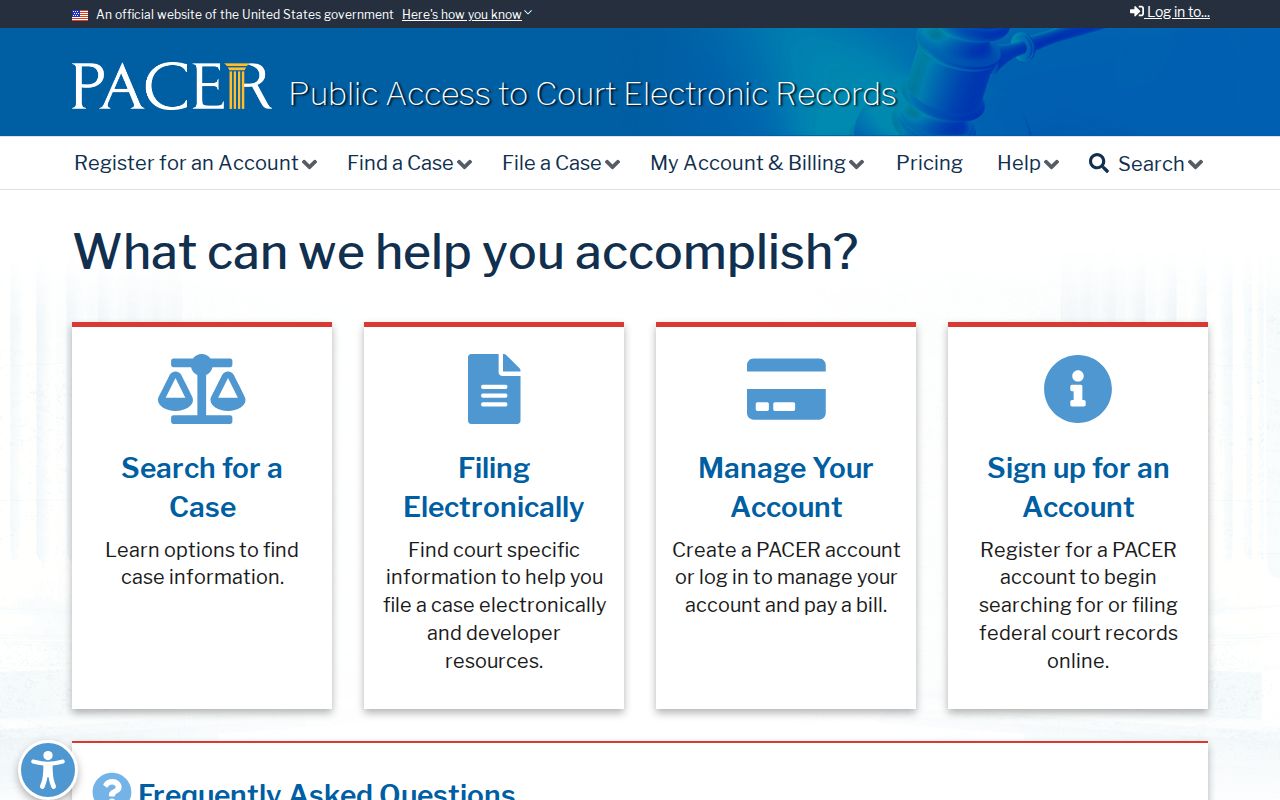
PACER supplements rather than replaces WebCriminal and the Allegany County Court clerk because the systems cover different jurisdictions.
Access Rules for Case Records
Public access has firm boundaries. Sealed cases, grand-jury records, youthful-offender files, protected victim information, juvenile matters, and other confidential material are not ordinary public court records. Criminal Procedure Law sections 160.50, 160.55, 160.57, 160.58, and 160.59 govern several New York sealing routes. CPL 720.35 restricts youthful-offender records. The New York Legislature law search provides current statutory text.
A missing online case may reflect a move, an older paper file, a closed matter outside WebCriminal's focus, a spelling issue, or a legal restriction. Ask the clerk to search by the best available identifier. Judiciary Law section 255 addresses lawful clerk searches and certifications, but it does not override sealing. County FOIL covers executive-agency records and cannot force disclosure of a court file or DCJS rap sheet.
The Allegany County District Attorney page identifies the prosecutor's local role.
The District Attorney prosecutes cases but is not the public court-file counter; request the judicial record from the clerk that maintains it.